

The Vision for the Vermilion Lagoons (1928)
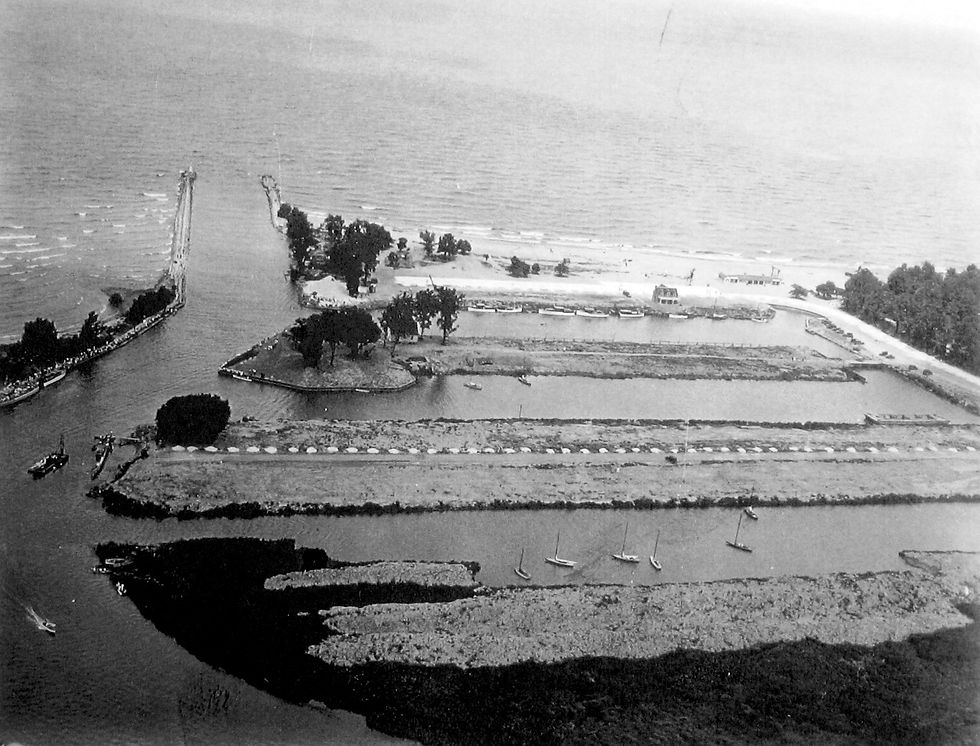
In the early twentieth century, the land between Linwood Park and the Vermilion River was little more than low-lying swamp owned by the Linwood Park Association and Patrick Smith. Neither owner had plans to develop the property.
In 1928, contractor Lou Wells, owner of the L.A. Wells Construction Company, saw something different. He envisioned transforming the marsh into a waterfront residential community featuring:
• Lagoon-style waterways
• Waterfront homes
• A beach and pavilion
• A yacht club with docking facilities
Wells purchased the property and began dredging channels to form the Vermilion Lagoons. The work also allowed him to keep his dredging equipment active during the winter months.
By 1929, major progress had been made. The lagoon channels were dredged, three homes had been built, and a beach pavilion and bulkhead were constructed at the end of Anchor Way. Access to the Lagoons originally came from Lake Road (Liberty Avenue) and Park Drive, connected by a bridge between Park and Portage Drives near present-day Willow Lane. The bridge was removed in 1931 when the current entrance near Linwood Park was created.
History of the
Vermilion Yacht Club*
The story of the Vermilion Yacht Club begins with the transformation of a quiet stretch of marshland along the Vermilion River into one of Lake Erie’s most vibrant boating communities. From its beginnings during the depths of the Great Depression to the thriving family club, it is today, the Vermilion Yacht Club has been shaped by vision, perseverance, and a shared love of boating.
*Based on history by Commodore John G. Robinson, Inter-Lake Yachting Yearbook (1965), p.67 and later additions by Mrs. Robert M. Henshillwood



Promoting a Boating Community
To promote the new development, Lou Wells partnered with John G. Robinson, editor of Power Boating magazine. The first announcement of the Vermilion Lagoons appeared in the January 1930 issue, followed by consistent advertising from the Wells Realty Company.
That winter, Wells and Robinson traveled to Vermilion to present the investment opportunity. Wells offered to donate land for a yacht club on the condition that the community would build the clubhouse.
Despite their enthusiastic presentations—and even offering complimentary refreshments—the proposal initially failed to attract supporters.
A Near Miss in 1932
The idea of establishing a yacht club resurfaced in 1932 when the Cleveland Yachting Club faced financial challenges. Their Rocky River Island location had become costly due to high rent demanded following a bankruptcy years prior.
Lou Wells proposed that the Cleveland Yachting Club relocate its headquarters to Vermilion. In exchange for building a clubhouse and docks, Wells would donate the land entirely.
The proposal was presented at the club’s annual meeting that fall. It failed by a single vote — 16 to 15.
The narrow margin highlighted how close Vermilion came to becoming its permanent home.
Founding the Vermilion Yacht Club (1933)
Only weeks after the vote, Wells approached several Cleveland Yacht Club members with a new idea: Create an entirely new yacht club in Vermilion.
On January 19, 1933, a group of yachtsmen met at the Cleveland office of W.P. Hurford on West 9th Street and officially formed the Vermilion Yacht Club.
The first officers were:
• William H. Thomas – Commodore
• C.R. Warner – First Vice Commodore
• W.P. Hurford – Second Vice Commodore
• John G. Robinson – Rear Commodore
• C.L. Chafee – Secretary-Treasurer
Commodore Thomas had served as Commodore of the Cleveland Yacht Club the previous year.
There were only twelve charter members, but they moved forward boldly with plans to build a clubhouse and create dockage for their boats.
To protect the club’s property, two organizations were established:
• Vermilion Yacht Club – the membership organization
• VYC Co., Inc. – a corporation created to hold title to club property through appointed trustees
This structure ensured that the club’s assets would be protected from potential financial difficulties.
Building the Clubhouse
Club member Emory Rhodes drew plans for the original clubhouse. A contract was awarded to Rasmus Hanson of Cleveland for construction.
The total cost of the building was $3,000, a remarkeable figure even for the Depression era.
Twelve members personally signed notes guaranteeing the loan needed to finance construction. The debt was repaid in full within about a year.
Members themselves painted the interior and exterior of the building, while their wives’ organized parties, lectures, and events to raise money for furnishings.
The Vermilion Yacht Club was truly built through the dedication and hard work of its members and families.

1933 Emery W. Rhodes, Clubhouse Architect, designs our VYC Plans

1933 Team builds our“First” VYC dock structure

1933 Rasmus Hanson's Construction Team work on the original clubhouse, which was completed for just $3,000 during the Depression

1935 VYC Clubhouse

1939 VYC Members build a new walkway as Commodore L. Harry Stoner supervises
A Club Built on Friendship
From the beginning, the Vermilion Yacht Club was more than a marina or clubhouse. It was a close-knit, family-oriented community.
Despite its modest beginnings, the club quickly became an important part of the region’s boating culture and played a role in the growth of Vermilion from a small village into a thriving city along Lake Erie.
The success of the Vermilion Lagoons as a residential boating community stands as a testament to the vision of Lou Wells and the determination of the club’s founding members.
Preserving Our Club’s History
Over the decades, the Vermilion Yacht Club has preserved and celebrated its heritage.
For the club’s 75th anniversary in 2008, a series of historical videos was commissioned featuring reflections from 24 Past Commodores discussing their experiences and leadership of the club. These videos were presented at the Commodore’s Dinner, which saw one of the largest gatherings of past commodores in club history.


A Treasure from 1933: Our Story Begins
We digitally restored a rare 1933 16mm Cine-Kodak film, revealing a vivid glimpse of the club’s earliest days. The footage shows members building the original clubhouse and docks, bringing the grounds’ first chapter to life. In one memorable scene, a member pilots a sloop up the river and into the harbor—an enduring image of the spirit that still defines the club today.
-- No Video Sound --

A Living Piece of VYC History – Doryann II
One of the most remarkable pieces of Vermilion Yacht Club history is a boat that still sails today.
In 1946, Commodore Virgil H. Waite purchased a 1940 42-foot Chris-Craft cruiser named Doryann II, honoring his daughters Dorothy and Ann. Shortly after becoming Commodore, Waite and his wife Helen embarked on a three-week voyage through the St. Lawrence Seaway with fellow VYC members Paul and Jane Critzer.
Nearly 75 years later, that same vessel still cruises the waters of the Pacific Northwest.
Now owned by Jim and Margie Paynton of Seattle, the boat—renamed Maranee, meaning “Sea Princess”—continues to operate with her original twin 130-horsepower Hercules engines.
Through careful restoration and passionate stewardship, the Payntons have traced the boat’s entire ownership history, reconnecting with the families of each previous owner and even hosting members of the Waite family aboard decades after the original voyage.
Their work highlights something many boaters understand: classic boats often create lasting friendships and connections across generations.

Doryann II at VYC fuel dock in early 1940s. Earliest known photo of the Boat

Doryann II Maranee in 2017 at chatterbox falls, princess louisa provincial park, british columbia
Continuing the Legacy
Today, the Vermilion Yacht Club carries forward the tradition begun by its founders in 1933. What started with twelve charter members and a modest clubhouse built during the Great Depression has grown into a vibrant club dedicated to boating, friendship, and community.
The spirit that built the Vermilion Yacht Club—Vision, Cooperation, and a Love of the Water—remains the Foundation of our club today.
